
Technical Architecture
How we flipped the identity stack.
Instead of shipping raw human biometrics to cloud GPUs and trying to guard a toxic database afterward, FlippedStack moves compute to the user’s hardware and leaves only mathematics on the wire.
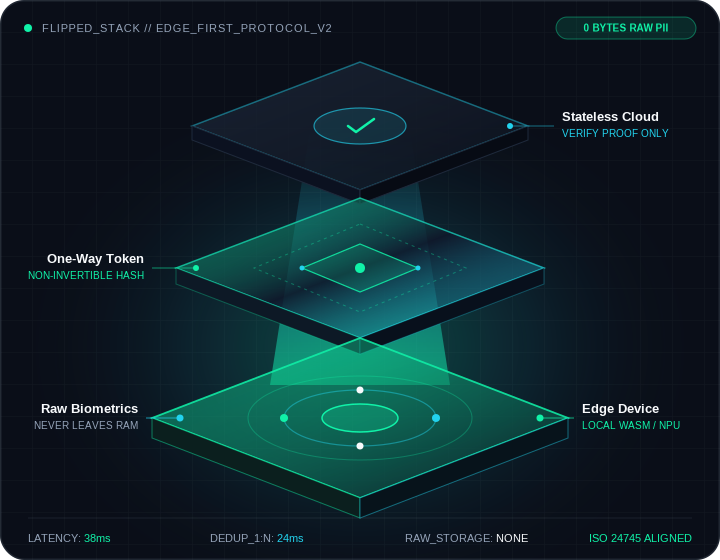
End-to-End Cryptographic Flow
Four deterministic stages from lens to signed proof.
Ephemeral In-Memory Capture
Camera frames or document scans are read directly into volatile device memory (RAM). No images are written to disk, browser storage, or transmitted over the network.
Local Neural & Forensic Execution
Quantized WASM/WebGPU or native NPU models run passive liveness, deepfake detection, OCR extraction, and facial feature embedding in under 45 milliseconds.
One-Way Cryptographic Projection
Biometric embeddings are irreversibly projected with application-specific cryptographic salts into cancelable verification tokens. Raw buffers are immediately zeroed.
Stateless Proof Verification
Your backend validates the signed attestation (JWS/W3C VC) and optionally runs constant-time 1:N token deduplication—verifying trust while storing zero raw PII.
Local Selfie-to-ID & Passkey Binding
For KYC and passwordless re-authentication, 1:1 comparison happens 100% inside the client runtime. The user’s live camera feed is compared against the ID portrait or hardware-bound passkey enrollment token without sending a single pixel to any external endpoint.
Constant-Time Anonymized Lookup
Need to guarantee one real human per account without storing faces? FlippedStack projects facial geometry into an unlinkable, cancelable cryptographic token. Server-side galleries match tokens in ~25 ms without any ability to reconstruct images or correlate users across tenants.